












Omaha Hi Lo Rules for Beginners | Learn Split Pots, Hands & Strategy! Omaha Hi Lo is the most rewarding type of poker to players who like more hand-reading, better drawing and more complicated post-flop decisions. Although the game resembles a regular Omaha, the main difference is the so-called split pot mechanic: in most hands, the pot is split between the best high hand and the best low hand. This structure will appeal to players who desire to have more action and more chances to win in one round.
This guide covers all the necessary rules of Omaha Hi Lo, the evaluation of the high and low holdings, the details of the 8 or better rule, the most effective strategies to enable new players to develop winning scopes and easy strategies that can guide you to a better player within the shortest time.
What is Omaha Hi Lo?
Omaha Hi Lo is a split-pot poker game where players are supposed to use two hole cards and three cards on the board to make a high hand and a low hand. In case of a qualifying low (eight or better) the pot is divided between the best high and low hands.
To anyone who wants to sink his toes in Omaha Hi Lo, understand the operations of split pots, and slap the tables with confidence, here is a simple and easy to follow guide.
What you’ll learn
- The split-pot mechanic who is necessary.
- Evaluation of high and low hands.
- The crucial 8 or better rule
- Starting hands that are best as a beginner.
- Common mistakes to avoid
- Scooping the entire pot strategy.
- Major variations with Texas Hold’em.
Omaha Hi-Lo: How to Play the Split Pot Game.

In Hi Lo as in Omaha, each player is given four cards which are privately dealt. There are five community cards that are used by the board. The basic principle does not change: you have to use two cards of your hand and three cards of the board to make your final hand.
The biggest distinction is in the way the pot is given. The pot is in most cases, though not all, split into two halves. One of these halves goes to the best traditional high hand. The remaining half to the qualifying low hand. That is why the format is commonly defined as high low poker rules or split pot Omaha. The mechanism and timing of this split is the basis of all the Omaha Hi Lo rules.
Difference Between Hold’em and Omaha Poker
New players of the variant assume that all pots are split sometimes. There are boards in practice which lack sufficient low-rank cards to make a qualifying low. The whole pot in such cases goes to the high hand.
What Newcomers should know about Omaha Hi-Lo.
Novices get into the format with the hope that it will resemble Hold’em with additional cards. The most widespread source of confusion is that assumption. The game compensates the game structure, patience and hand selection. It is not a free-roll game; it is a technical game with clearly stated rules of the game, known as Omaha Hi Lo.
In case you are new to the game, then the initial steps are:
- Get to know how to assess the high hand.
- Learn how to read the low hand.
- Memorize the 8 or better rule.
- Know why coordination of hands is important more than the rank of the cards.
- Opening of the building on both sides of the pot.
With all these factors together, you will start creating a basic yet correct Omaha poker guide to yourself. The more experience you have the more layers of strategy you will add to it, but you are firstly trying to learn how to play Omaha Hi Lo without committing structural errors that you can avoid.
In the case of complete amateurs, it is advisable to work out the format in a gradual, consistent structure. There is no need to make things complex. The easiest way is to learn the mechanics and get the discipline to fold unplayable hands. And this is where all solid beginners of the Omaha Hi Lo road maps begin.
High and Low Hands Reading in Omaha Hi-Lo.
The new players need to know how to read the two halves of the hand separately. The easiest method is to master high hands on the first hand, since they are ranked in the standard way. The high evaluation will be familiar to you in case you have played Hold’em or Omaha.
The learning curve starts at the low half. A low hand is a hand containing five different cards with a rank of eight or below. Pairs do not qualify. Straights and flushes do not qualify out a low. The optimal low would be A-2-3-4-5, commonly referred to as the wheel. Due to the nature of the rules, the calculation of the Omaha Hi Lo low hand always rewards the lowest top card first, the next lowest, and so on.
A-2-3-7-8 beats A-3-4-6-8, since the second hand has a 6 as the third card in the ranking and the first one has a 3. Such minor comparisons are important and this is why before making any predictable results, one should study the hands of Omaha high low.
It is also important to keep in mind that when considering the low, one needs to follow the rules of the high low poker precisely: he/she needs to use two cards in his/her hand and three cards in the board. Novices often err and believe that they can only make a low with one card in their hand. This is prohibited in any manner of Omaha.
Best Starting Hands in Omaha Hi-Lo Starting with Beginners.
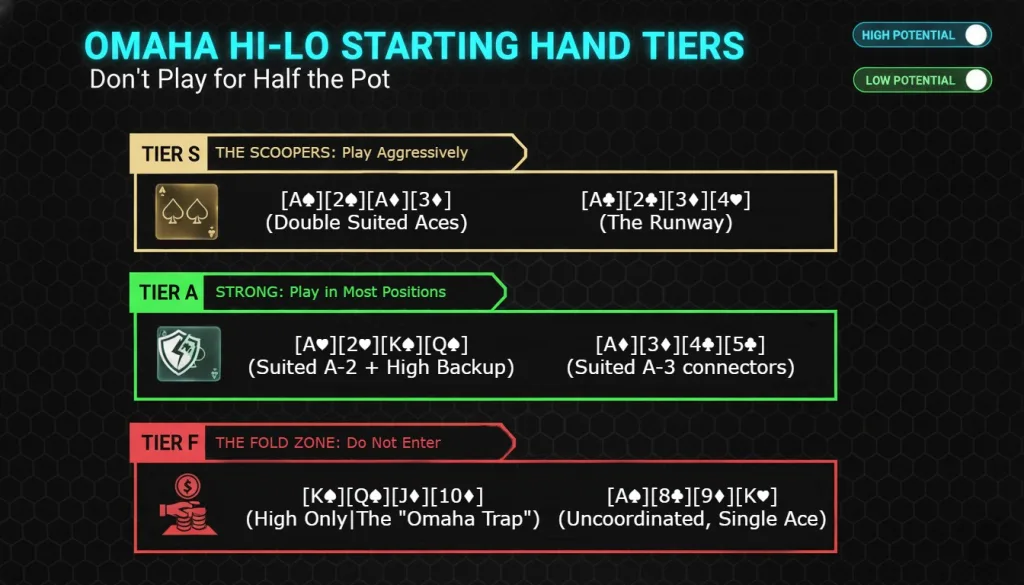
This game has good starting hands which are coordinated. They collaborate on either side of the pot. The best way to achieve early consistency is by having hands that are attacking the high and low halves with a good potential.
Good examples that are easy to understand are:
- A-2 with suited aces
- A-2-3-x hands
- A-3 with solid high-card backup
- Double-suited A-2-x-x
- A-2 with connected side cards
They are great Omaha Hi-Lo starting hands as they provide you with equity in various directions. When you have A-2-3-4 double-suited, say, you are fighting the nut low and extremely strong high-equity draws. This is the essence of easy-going decision-making.
Do not begin hands which are one-dimensional. High only hands like K-Q-J-T are attractive to Omaha players but hardly work in Hi-Lo. When you are unable to hold the bottom half with your hand, which is not really possible, you are in danger of being quartered or outdrawn on unsafe boards; a sure leak to beginners.
Most of the beginner errors are solved by good starting ranges. By adhering to these guidelines, then you will begin to develop a credible beginner Omaha plan that creates instant progress.
The play of the 8 or Better Rule in Omaha Hi-Lo.
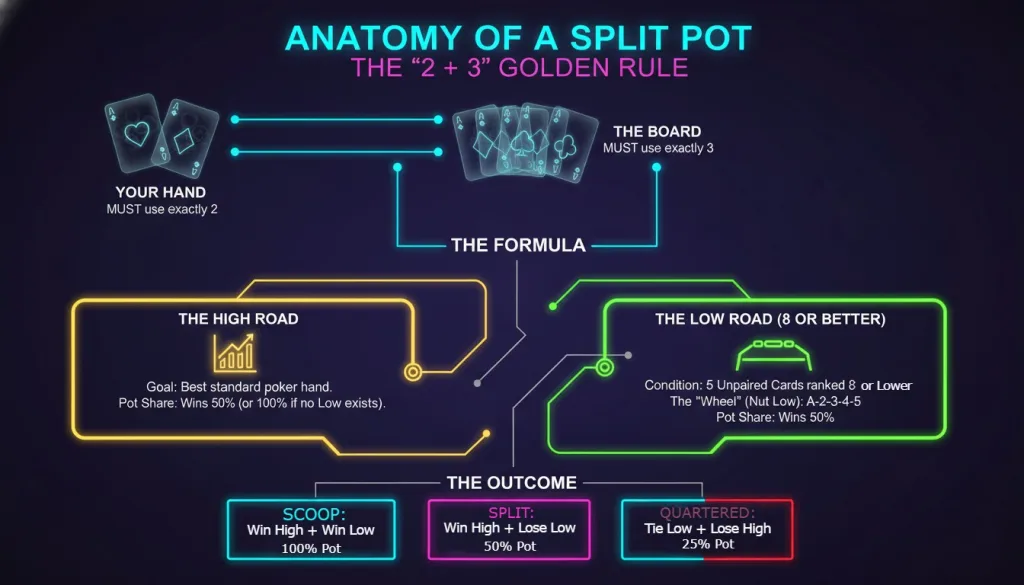
There is only one requirement of the whole low half of the format; the board should have at least three different cards with a rank of eight or less. This is the 8 or better rule and in the absence of this, there is no such thing as the low. Whatever low cards you have, you cannot make a qualifying low without the support of the board.
Once the board reaches the threshold, then players are allowed to use two of their hole cards to create a low. The point is that a qualifying low should consist of five cards (there should be no pairs) and should follow the standard Omaha Hi-Lo rules related to the utilization of two hole cards.
Top 20 Best Poker NFT Characters You Need to Know
It is important to memorize the interaction of the 8 or better rule with the board texture when one is a beginner. It makes you know whether a pot is going to be split or scooped. It also makes you know the times when it is more profitable to construct the best high than attempt to pursue a marginal low draw.
Common Bad Playing by Novices in Omaha Hi-Lo.
Structural errors are common among players joining the format and not strategic errors. Here are the most common:
- Placing high only bets in multiway pots.
- Placing too much value on vulnerable lows.
- Misreading qualifying lows
- Excessive calling using dominated A-x hands.
- Losing the memory of the fact that two hole cards are obligatory.
- Exaggeration of weak two ways hands.
Such mistakes are typical due to the fact that players wrongly bring Hold-em habits into the game that is ruled by other logic. Most of these issues are removed with strong fundamentals and the more this area is improved the better you perform. Most of the early Omaha Hi-Lo tips are aimed at cutting loose starting hands and circumventing traps of situations.
Easy Tips to Win More Split Pots in Omaha Hi-Lo.

It is not a matter of aggression to win more split pots. It is about clarity. The simplest Omaha Hi-Lo strategy to use as a beginner is to strive to play such hands, which can win both halves of the pot. This is what is referred to as going for the scoop. When you habitually enter pots with A-2-3-x double-suited or other such coordinated holdings, you are in a position to get full pots instead of half.
Successful first mover strategy involves:
- Premium A-2 combination play.
- Folding marginal A-x low drawdowns.
- Avoiding high-only holdings
- Preferred the use of double-suited structures.
- Knowing how to know when a low is live.
- Folding prevailed in lows of multiway pots.
It is an easy method of learning Omaha Hi-Lo without any extra complexity. By playing in scoop mode instead of split mode, the game becomes less complex.
The Best Sites to Practice Playing Online Omaha Hi-Lo Where to Find Them.

Omaha Hi-Lo is available on many sites, and the true beauty of this game to a novice is to find a site with small stakes tables, active player traffic, and useful hand histories. The prerequisites before choosing a platform to practice Omaha Hi-Lo are to make sure that the lobby has running micro-stakes games and has Omaha filters.
Once you become familiar with these games, continue to go back to the basics: tight hand choice, adherence to the split pot rules, and low evaluation discipline. This is the way players can create their own guide of Omaha poker by experience.
Further reading
The Omaha Hi-Lo has a comprehensive external references.
- Super/System by Doyle Brunson (2002) contains some of the basic Omaha Hi-Lo principles of poker champions, which form the basic split-pot strategy principles.
- Omaha Hi-Lo Poker by Bob Ciaffone (1997) is a classic work, providing a break-even analysis of the following mechanics of hand selection, equity and the rule of 8-or-better.
- Winning Omaha/8 Poker by Mark Tenner and Lou Krieger (2004) is a well-organized and easy-to-follow introduction to the analysis of starting hands and pitfalls to avoid.
- Mark Blade has written the book Professional Poker (2006) with more sophisticated analysis of scooping strategies and equity realization in split-pot games, between beginner and intermediate concepts.
- The course in Poker Theory and Analytics (Massachusetts Institute of Technology) uses up-to-date applications of game theory to Omaha variants, which is a current reflection of strategic developments.
- Starting hand performance in Hi-Lo structures is provided empirically in the archives of key statistical hand rankings and equity studies published in the Card Player Magazine.
- A large body of historical discussion in the archives of the Two Plus Two Poker forum has been the decades-long discussion and refinement of Omaha Hi-Lo strategy by elite players.
Further Reading (Internal)
- Omaha Poker Variants Explained | An Overview of Omaha Poker as a beginner. A starting point of players comparing Hi-Lo to Omaha High, Omaha 5 and Omaha 6.
- Best Low-Stakes Strategies to play online poker as a beginner. Perfect for those players who have mastered the rules and are ready to move to real-money Omaha Hi-Lo.
- Knowing the Structures of Poker Hands: High, Low, and Split Pots. An in-depth analysis of hand evaluation mechanics in a multi-format perspective.
Glossary
- Scoop: The winning of the high and low halves of the pot.
- Nuts / Nut Low: The optimum hand of high or the optimum hand of low.
- Wheel: A-2-3-4-5, low hand of the best possible (and, often, strong straight) high.
- Quartered: when you and another player have a tie for the lowest hand resulting in one of you being left with just a quarter of the winnings.
Best GTO Solver Software: Improve Your Poker Strategy
FAQ: Omaha Hi-Lo rules
What is Omaha Hi-Lo?
- It is among the most easily available methods of learning Omaha Hi Lo since the structure favors good two-way hands and decisive decision-making.
How does the split pot work?
- The Omaha Hi Lo split pot takes place when there is a qualifying low of less than 8 or better rule by the board. Then half the pot is split on the best high hand and the other half is on the best Omaha Hi Lo low hand. In case no low is qualified, the high takes the pot, according to the regular rules of high low poker.
What is 8 or better in Omaha Hi-Lo?
- The 8 or better rule determines the manner of playing Omaha Hi Lo in the assessment of the low side: a low hand should include five different cards with the ranking eight or less.
What makes me know whether my hand is a low hand or not?
- Only when you can form a combination of five different rank cards eight or less with only two hole cards, does your hand qualify as an Omaha Hi Lo low hand.
Is Omaha Hi-Lo more difficult than the Texas Hold’em?
- Not necessarily. Omaha Hi Lo is more organized but upon learning the rules of Omaha Hi Lo and the split pot concept, the game is easy to play. The simple beginner Omaha strategy has made it easy to learn as many new players discover that it is not as difficult as it looks.
Which hands are the beginners supposed to play?
- Novices ought to practice high quality Omaha Hi Lo starting hands such as A-2, A-2-3-x and double-suited hands that would win both the high and the low half.
Is it profitable to only have high hands?
- High only hands do not work well in Omaha Hi Lo as they cannot compete on the low side. In the case of Omaha Hi Lo beginners, it is a good idea to select coordinated holdings which abide by the principles of the Omaha poker guide as well as good two-way play. High only hands tend to be against fundamental Omaha Hi Lo to the beginners.
What are the Best Online Platforms for New Users Wanting to Explore Omaha Hi-Lo?
- The novices may begin practicing Omaha Hi Lo on any site where it is possible to play low-stakes or micro-stakes games with a regular flow of traffic.