












All Types of Rummy Games in One Place | Rules, Style & Difficulty! Rummy is played over quick Gin games to 21 card marathons; this guide will be used to trace the rules of each game, its difficulty and when the use of algorithms is the most important.
Being confused about numerous types of rummy? Understand the regulations, evaluate the challenge and find out when RTA or white-label platforms are the smart move.
What is Rummy?
Rummy is a card game that is popular and players strive to make sets and runs of cards. It exists in different forms, whereby the more the cards and decision points, the more complex it becomes. More sophisticated forms of the game may use Real-Time Assistance (RTA) tools by players to improve strategy.
Rummy, either in its traditional 13-card version or with more advanced 21-card version; it is one of the most recognizable card games in the world, and it is praised as a combination of skill and strategy and socialization. As the Internet gaming has emerged, rummy has spread out to various formats with different rules and complexities.
You can be a beginner, who wants to learn the basics of the game, or a more experienced player, who wants to upgrade and have an advantage over the opponent, this guide will provide you with a deep insight into the various rummy variations, their rules, tactics and how technology, such as Real-Time Assistance (RTA) can help you win.
What You’ll Learn:
- The core values that are used to play any type of rummy.
- Some of the main distinctions between the traditional rummy.
- The variants that require more cards such as 13-card and 21-card rummy become complex with a corresponding increase in the number of cards.
- Key tactics of playing the various types of rummy.
- The benefits of automation and AI (including RTA tools) on your play.
What Is Rummy? A Rapid Introduction to the Styles of Gameplay.
Core Mechanics
Rummy is based on a dynamic decision tree, which deals with sets, runs, melds and discards, and is very simple at the core of the game. A set is composed of three or more cards of the same rank whereas a run is composed of three or more cards of the same suit.
The game starts by the players drawing and discarding cards in turns, all in the process of trying to make valid sets and runs. The game is terminated when a player combines their cards in sets and runs either terminating the round by disposing the last card or attaining a set score.
Average Number of players and Table Action.
Games of rummy are usually played by 2 to 6 players, though some can have more, such as Canasta. Many variants use a 4-player table, which offers a balanced playing experience unlike a 2-player game that relies on strategy only or a 3-player game that relies on interaction only.
During each round, players pick a card either in the stockpile or discard pile and then dispose of a card, to strike a balance between offense (creating sets and runs) and defense (defending against the potential melds of the opponent).
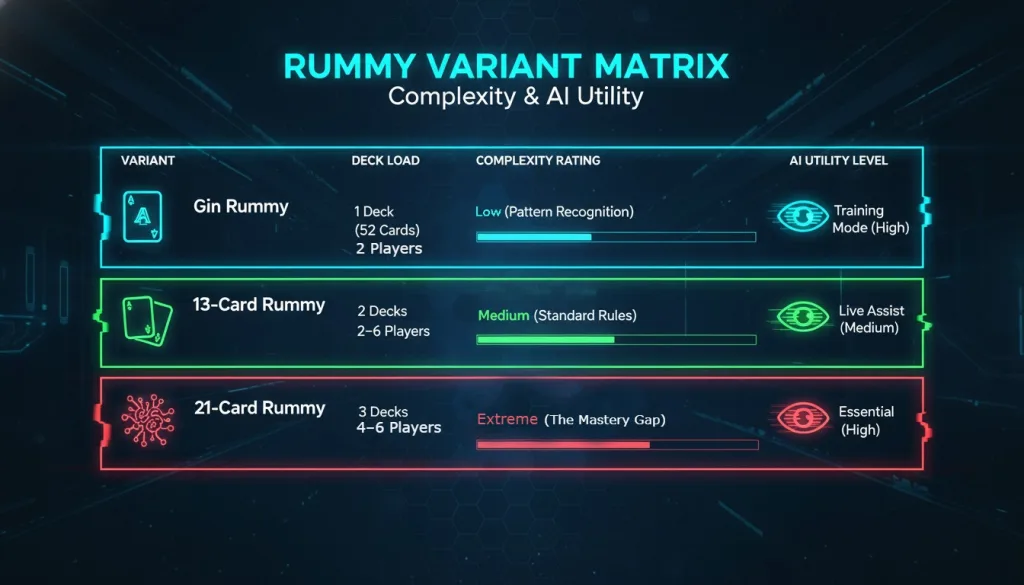
The variants of rummy are similar in the decision tree, draw, discard, meld, but the complexity of the game increases with the number of cards.
Serious professionals investing in Rummy AI software are able to significantly increase their ROI.
Old Rummy Variations: Standard Rules to the Contemporary Variations.

13-Card Overview
The 13-card rummy is the most popular type of rummy, which uses two decks of cards and usually has 2-6 players. In this game, the players will be expected to make combinations of sets and runs out of their 13-card hand. There are variations; use of joker and regulation of meld time, yet all these are based on the fundamental mechanics.
Gin vs Classic Differences
Another traditional variant is Gin Rummy, which in a number of ways is different. To begin with, it is normally a two-player game. This is aimed at creating a hand of sets and runs, with the least number of unmatched cards (deadwood). Contrary to regular rummy, in which the players are attempting to combine all the cards simultaneously, Gin Rummy makes the players knock early with a small deadwood, and this introduces an element of strategy regarding the time of the round.
Minor changes in rules such as joker rules or meld thresholds can make the strategy of optimal change drastically.
Our AI-driven rummy bot is here to take the weight off your shoulders, and help you focus on strategy, when faced with the complexities of math in Rummy. Play to win in the traditional rummy using our “Variant Sheet; full of professional tips to play better.
Indian Rummy: Rules, Structure of the gameplay and level of difficulty.

13-Card Rules
Indian 13 card rummy uses the same rules as the traditional game, but there might be slight difference in the rules of counting and playing. The goal of the players is to create at least two sequences (one of them should be pure) and a combination of three cards of the same rank. The rules are simple, but the play becomes more complicated as the strategies develop.
21-Card Complexity
The 21 card version, also known as Indian Rummy, adds a lot of complexity. With more cards on the table, the level of more complex decisions increases drastically. This increases the number of cards, and so most players can’t keep track of the cards and calculate the probabilities without the help of an algorithm.
The decisions of 21 card rummy are too numerous to be tracked by hand.
21 Card Rummy is complex enough that an algorithmic solver is needed for tracking the cards.
RTA tools are essential to serious players. Think about having a Real-Time Assistance (RTA) which is your complex insurance.
Gin Rummy: Rules and Strategy and Why It is so Popular.
Gin Scoring
The Gin Rummy has a different scoring and endgame format as compared to other forms of rummy. In Gin, a player is allowed to knock with less than 10 points of deadwood, whereas in the classic game the game is played in such a way that one is supposed to form combinations as the game continues. The game also rewards players who are able to identify hand patterns and discard them in the most efficient way possible, which is why it is an ideal fit to train with an RTA tool.
Gin is a good candidate to training-mode RTA since it rewards players who are good in pattern recognition.
You are willing to play your Gin Rummy? Test RTA training mode to achieve the final advantage.
Points Rummy vs. Pool Rummy: Major Differences and Skill Level of the players.
Points Rummy Mechanics
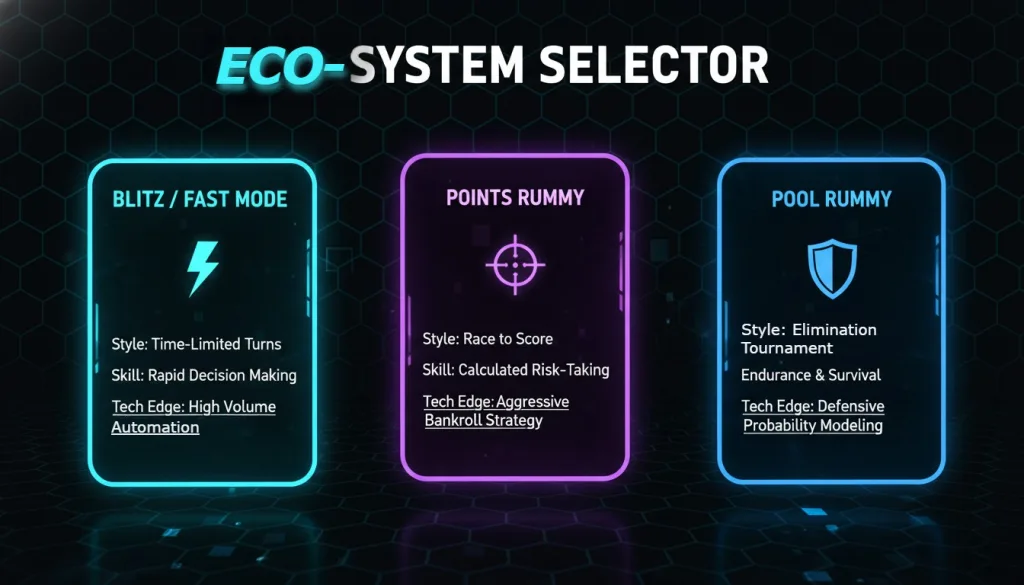
In Points Rummy, the goal of every player is to win rounds in order to have a predetermined score. It is generally more aggressive and focuses on rapid, calculated risk-taking, which is more appropriate to players who have an aggressive bankroll strategy.
Pool Rummy Mechanics
Conversely, the Pool Rummy involves a fixed amount and the winner takes the pot and is more endurance based. It involves a multi-round strategic planning because the players need to take care of their risk in order to last longer in the game.
Pick an option based on risk-taking: Quick win’s point, long-term pool.
Test your rummy style by the type of bankroll and time commitment that fit your rummy style by taking our Format Selector quiz.
Types of Online Rummy Game Fast, Competitive and Multiplayer Rummy Game.
In our Blitz modes we have an autopilot cash game strategy that ensures you never miss an opportunity to play.
Blitz/Fast Modes
There are also Blitz or Fast Rummy online where one has to make decisions within a time limit and make decisions on the spot. These rapid modes are more automation friendly, and hence are suitable to players who desire to maximize their volume without losing precision.
Tournament Structure
Online rummy tournaments, on the contrary, are more tactical and reward players who are able to focus during a long duration. There are also sophisticated tactics that are used in tournament play, especially in stack management and table management.
Fast modes are volume-based and tournaments are depth and strategy-based.
Would you like to work in various modes? Questions of us: secure multimode deployment.
The way to select the most optimal Rummy variant depending on the skill and strategy.
In choosing the type of rummy to play, you have to look at the amount of time you have, how much risk you take, and what your level of skills is at the moment. It is encouraged to first learn 13-card rummy variants, and then learn more complicated variants such as 21-card rummy. RTA or bots are a way to increase your skill ceiling in rummy games. They provide a performance increase when playing at a higher volume.
In case you would like to win regularly, you should prefer a variant that fits your strengths in RTA.
Get RTA to play your favorite version of rummy and begin maximizing your ROI today.
Rummy difficulty Level: Which Version Is Easier to Play?

The easiest examples such as Gin Rummy or 13-card rummy (no joker rules) are considered to be the most appropriate to play first as they have a lower number of variables and it is not so difficult to learn the game before proceeding to 21-card rummy which involves more strategy and decision-making abilities.
- Start with simplified tables of Gin or 13-card rummy, before progressing to the more complex 21-card version.
- If you are a new rummy player, then you can join our beginner level Rummy Tournaments and become an expert rummy player in no time.
- Most rummy games have similar rules, but with more cards, the difficulty level required to lay down melds increases.
- Simple forms of rummy, such as 13-card rummy and Gin, are easier to learn, while an Indian 21-card rummy is far more complex.
- Additionally, automation via artificial intelligence techniques such as RTA can help simplify or assist a player in dealing with the complexity in advanced rummy variants.
If you want to have a competitive edge, install Rummy software with built-in AI that will guide your platform to the top.
Further Reading
- India Online Rummy Market Size (Statista/Redseer Strategy Report, 2024): The ultimate market intelligence report that measures the billion-dollar growth of the sector, which is a key citation to the commercial magnitude and opportunity.
- “AI is Reshaping Rummy and Online Gaming” (GadgetsNow, 2025): An industry report with CEOs of the platforms directly commenting on how AI is being used to operate the platform, protect players, and comply with the infrastructure.
- Popular Variations of the Rummy Game (LinkedIn Industry Analysis, 2025): A credible resource that determines the further prevalence and certain complexity of the 13-Card and 21-Card variant of Rummy in the world and Indian market.
- White Label Rummy Solutions: Platform Overview (Digient, 2025): The authoritative commercial treatise of the combined attributes including AI applications up to payment gateways that constitute modern scalable turnkey platform infrastructure.
Top Rated Poker Bot: Top Performing AI Tools Compared!
Try our demo above on the right side or drop a message to contact our customer services.
Glossary
- Rummy: A set of similar-card games in which the players are expected to make valid sets and runs out of the cards they have in their hand.
- Set: A winning set in rummy that is made up of three or four cards of the same rank, but of different suit, e.g., 7♠, 7♥, 7♦.
- Run (or Sequence):A rummy combination consisting of three or more cards in a row and same suit like 4♣, 5♣, 6♣ of the same suit.
- Meld: This is the process of laying face-up sets and runs on the table to call them which is necessary to win a round.
- Deadwood: The uncombined cards in the hand of a player after one round is over, in a game such as Gin Rummy this deadwood is counted as points.
- Real-Time Assistance (RTA): Computer programs that apply algorithmic analysis to offer strategic advice to the player in real-time, e.g. the best discards, or the best prediction of opponent hands.
- Points Rummy: This is a variant of Rummy played in rounds where participants are challenged to get a set amount of points before the other.
- Pool Rummy: This is a variation of rummy, which is played in the form of a tournament, with each participant paying a set amount as an entry fee to a purse, and is eliminated when they reach a certain number of points.
- Blitz/Fast Mode: This is a type of online rummy that has strict time constraints per turn, and is based on the idea of playing the game as quickly as possible, which is conducive to making decisions quickly and playing lots of rummy.
- White-Label Platform: A complete, open-source software platform that enables companies to create their own branded online gaming product without having to develop the technology itself.
FAQ: All Types of Rummy Games
What are the key rummy games that are played nowadays?
- The most common forms of rummy include the 13-card rummy, 21-card rummy, Gin Rummy, Points Rummy and Pool Rummy. The rules vary with different versions, but one thing that is common to all versions is the mechanic of drawing from a pile, discarding from the hand and melding cards in valid combinations.
What is the easiest rummy game for beginners?
- Two games are most suitable in rummy among beginners. These are Gin Rummy and 13-card rummy (no joker game). The regulations of such formats are easy and not complicated, yet perhaps too dull to hardcore players. The same applies to the card combinations that are also easy to handle and use. Therefore, they are easy to learn by beginners to master the fundamentals before proceeding to a more complicated game such as 21-card rummy.
How are the rules different for different popular rummy formats?
- Variations of Rummy change depending on cards being dealt, players and the use of jokers. Gin Rummy is played with easy knocking and 2 players and 13 card rummy is played with tough hands and 21 card rummy is tougher with more number of cards and combinations of pairs.
What is Special about Online Rummy Styles?
- There are numerous types of online rummy. These are blitz modes, tournaments and cash tables. Each serves a specific need. Automation, fraud detection and real time assistance (RTA) tools present in these formats add new elements that do not exist in classical, physical rummy.
Are the levels of difficulty similar in the versions of rummy?
- No, the various versions of rummy vary in the level of difficulty. In most cases, the novices find the 13-card rummy simple and the 21-card rummy complicated because of the number of cards and choices.
Are the levels of difficulty similar in the versions of rummy?
- Rummy is not equally challenging in different forms. New players find the game of 13-card rummy easier than the 21-card rummy. The latter is much more complicated with numerous additional cards that should be played and choices made.
Are there any safe ways of beginners playing advanced rummy?
- Yes, however, it is preferable to have simpler versions of it such as Gin Rummy or 13-card rummy. It is then possible to proceed to some more complex variations such as 21-card rummy.
What is the number of players that are suitable in each type of rummy?
- Rummy 13 cards can be played by 2 to 6 players.
- This game is best played by 4 to 6 players because the cards are slightly higher.
- Gin Rummy: This is a game that can be played by 2 players and therefore makes it to be more focused and strategic experience.
- Points Rummy and Pool Rummy: The choice of the game may be made by up to 2-6 players and quicker the game the larger the pool and the more challenging the game may be.
Which Rummy game is the quickest to play?
- The games are time-limited, and you need to make your choices as quick as possible and that is why Blitz rummy is the fastest game. This is a format that is played by players who want to play fast without thinking. This will maximize volume in case you desire.