












What Is Shanky Hold’em Bot? Complete Guide for Players & Developers! Shanky was the robot that made the poker world realize the importance of automation. The same question remains unanswered by operators, developers and players 20 years later: does Shanky have any real value in 2025? We can deconstruct the technology, the dangers, the history; and the artificial intelligence systems that supplanted it.
Anyone doing research on what is shanky bot or early poker bot history will eventually stumble on this once famous script.
What is the Shanky poker bot?
The Shanky poker bot is a legacy online poker bot that is based on scripted, rule-based decision trees. It automated play with fixed profiles and connectors, but without learning, flexibility, and security, becoming outdated and easily spotted on the contemporary poker sites.
The Shanky Hold’em Bot was the past master of the automation of poker. However, is it still relevant in 2025; now that the whole terrain has been transformed by modern AI, GTO engines and real-time detection systems? This guide dissects what Shanky was, how it operated, why platforms were afraid of it and what is the current tech turned out to be. The platform defenses were referenced to the Shanky poker bot.
What You’ll Learn
- What the shanky hold’em bot really was and why it blew up in popularity
- How its decision-making engine was rule-based.
- Shanky components (profiles, connectors, supported rooms) were powered by the following components.
- How contemporary GTO tools and adaptive AI are superior to legacy bots.
- Customization practices, risks, detectability and safety logic.
- What players, operators, and developers need to know in 2025.
Shanky Hold’em Bot Overview
Shanky can be described as the prototype of early automation of online poker: a script-based and deterministic bot that was designed to play millions of hands with no learning. Understanding what is shanky bot requires to look at the era of the early poker bot history, where simple poker bot software changed the platform security.
It sold thousands of copies, became widely known, and had to compel large poker rooms to upgrade their defensive systems in the late 2000s and early 2010s.
Shanky did not depend on data, solvers or adaptive logic. It ran scripts. It made pre-determined profiles and fixed rules to decide whether to fold, call, or raise. The attractiveness was straightforward: low-cost simple plug-and-play automation to ordinary people.
Early commercial bot analyses and scholarly views on rule-based agents indicate that Shanky has contributed to the democratization of poker automation; and at the same time, increased the security armsrace.
How the Shanky Bot Works When Playing Hold’em Poker?

Consider a bot which uses the same logic tree on each hand. Shanky lacked any learning or adaptation or exploit code; he had a fixed decision script.
Its design may be interpreted in the form of a simple loop:
- Perception: retrieve basic elements of the screen by analysis of memory or extracting data.
- The rule engine is directed by scripted heuristics when it is evaluating the hand dynamics.
- Select your move such as fold, call, or raise, according to the stipulated profile and strategy.
- The timing sequence is strictly repeated in precise intervals calculated in milliseconds.
The poker bot strategy used by Shanky was in practice a fixed decision engine.
Decision Pipeline (Perception guides to Rule Engine and that to Action)
Shanky was able to deconstruct screen data about pot size, bet size, position, hole cards and board texture. Then it implemented predefined rules, which could be edited by the user.
These regulations were not altered according to the tendencies of population. A human being would pick up a loose opener or a passive big blind; Shanky was just acting off papers.
Time and Mimicry of Man
The most obvious weakness of Shanky was that it was predictable in terms of timing. Human players play differently in terms of pace; bots such as Shanky do not. This was taken advantage of by detection teams. Because this bot was not designed with adaptive logic, it was not able to emulate a truly customizable poker bot like modern systems try to.
The deterministic reasoning of Shanky rendered it foreseeable; and, ultimately, traceable.
This deterministic style is the reason that earlier forms of poker bot software gradually became predictable. To understand why the bot gained such popularity, one should know what it consists of and what rooms it supports.
The Most Important Elements Of The Shanky Hold’em Bot including Poker rooms supported
Shanky was designed on three pillars: the engine, its profiles and its connectors. These combined to make it very easy to use by non-technical users.
Core Components Checklist
These Shanky bot scripts provided an easy, yet rigid means of behavior control to the user.
- Strategy to Pre-Flop and Post-Flop Cases.
- Profiles: Scripts which can be edited to determine the way the bot plays.
- Connectors: Interfaces to allow compatibility between poker rooms
- UI Layer: Setting control, timing and action logic control.
The selling point was profiles. Users were able to load aggressive, conservative or mixed profiles; like changing playbooks in a strategy game.
Being one of the earliest online poker bots, Shanky had to depend on fragile connectors. A Shanky bot profile, when properly tuned, could be almost a customize-able poker bot, although the illusion was broken by the modern detection systems.
Profiles and connectors made Shanky mass usable; and they developed the very fingerprinting techniques that brought it down. Here the evolution can be seen. Modern AI is only comprehensible in terms of the leap in the fixed rules to GTO and adaptive engines.
Strategies for building a GTO Tool and Decision-Making System
In the past our casino systems’ architecture was no match for today’s AI poker applications and GTO based bot designs.
CFR and Solver Fundamentals
Counterpart Regret Minimization (CRM) is a regret which players use in their decisions which continues until equilibrium is reached and is applied in heads up limit Hold’em by engines like Cepheus that which have been developed out of script based frameworks through to more complex CRM based frameworks. Also, this is the base which engines like Cepheus which were able to solve heads up limit Hold’em run on.
In the history of poker bot development what we saw was the trade in old script based frameworks for the CFR ones.
Hybrid GTO + Architecture of Exploitation.
Contemporary poker engines have a mixed architecture of GTO and exploitative elements which include a base of GTO to prevent strategic breaks and a behavioral analysis component which reacts to the actions of the opponent. We have large scale training data and dynamic calibration which allows the strategy to change in real time.
This is what we have achieved with our model which outperforms the past systems like Shanky.
Shanky Hold’em Bot user Profiles, Scripts & Customizing

The majority of users played Shanky using Shanky bot scripts, a pseudo-customizable poker bot framework. The heart of customization of Shanky was profiles. Every profile specified the behavior of the bot on all nodes of the hand; between open-raising frequencies and turn c-bet frequencies.
Anatomy of a Profile
The characteristics of a typical Shanky profile were:
- Pre-flop charts
- Strategic action tables: raise, call or fold position.
- Post-flop aggression rules
- The frequency of bluffing and calling.
- Bet-sizing presets
- Timing randomness (optional)
The checklist below was created to help ensure that the customization is safe.
Do:
- Add timing variance
- Keep bet sizes realistic
- Have test in low stakes conditions.
Don’t:
- Remove all randomness
- Over-tighten scripts
- Duplicate marketplace profiles anonymously.
Marketplace profiles were trendy; however, most of them became more detectable as human variance was eliminated. It is here that the majority of the Shanky bot scripts could be singly identified.
The greatest selling point of Profiles was also the greatest risk factor of the product.
Customization came with performance, and trouble. Next we come to the aspect that is of the greatest interest to the reader, that is, safety and detection.
Potential Risks of being detected and Safety Precautions to consider
The greatest misconception regarding Shanky is that it was something that could not be detected. No bot is undetectable; not in 2025. Any type of online poker bot, no matter how sophisticated it is, leaves traces.
Multi-layer systems are used in detecting platforms:
Detection Signals & Countermeasures.
Optimized poker bot strategy trees also provide consistent frequencies which can be isolated by detection teams.
- Timing consistency
- Lack of human error patterns
- Non-adaptive frequencies
- Irregularities in mouse-movement.
- Unrealistic multi table behavior.
Countermeasures include:
- timing variance
- mixed action frequencies
- safe session management
The management of intellectual property and the promotion of using various devices is not an exception. However, despite all the precautions, the ToS violation is a sufficient reason to close the account or confiscate the bankroll.
Legal & Platform Risk Matrix
All large poker rooms prohibit bots. In certain jurisdictions, botting is considered as either fraud or unauthorized access. The use of poker bots is discouraged by all operators and outlawed by terms of service. The principle that an online poker robot could stay unnoticed in the long-term is misplaced.
Setup Requirements For Both Players & Developers To Use The Shanky Hold’em Bot

Requirements To Set up both the players and the developers to use the Shanky Hold’em Bot. Shanky made automation approachable since the installation was easy. However, simple was always relative, in the backroom the bot was relying on connectors, local environments, and particular OS settings that are seldom survivable in 2025 environments.
This is a good place to begin to know where legacy tools fail and where modern AI is requiring more power.
Player Requirement Checklist (Legacy Requirements)
The installation of Shanky as an end-user was in a three-piece pipeline. To initially run legacy poker bot software, such as Shanky, it was required that:
- Hardware:
- Windows desktop machine
- Constant CPU (single thread performance was important)
- Small RAM footprint (Shanky was small, however, connectors were not)
- Operating System:
- Windows XP/ Vista / 7 compatibility.
- Memory-reading modules privileges of the administrator.
- Legacy .NET dependencies
- Connectors:
- Screen parsing connectors in local poker-rooms.
- DLL based interaction + DLL interaction is now completely blocked on modern clients.
- Manual version matching
- Data Sources:
- Mainly analyzes the on-screen game state, and hand histories are occasionally analyzed.
- None real-time population analysis.
- No solver integration
- Troubleshooting Checklist:
- Check connector version compatibility
- Turn off graphics overlay and third-party applications.
- Only legacy rooms (modern rooms block)
- Watch timing modules do not go out of sync.
Deprecation Warning
Most of these requirements do not even work today. To a contemporary developer of a poker bot, the infrastructure will look entirely different. Poker clients are encrypted game-state messages, anti-scraping, and executable hardening; obstacles that Shanky can not overcome. Legacy setups are fragile. They relied on lax OS layers and unsecured poker clients; neither of them exists nowadays.
Developer Environment & Data Needs (Modern Perspective)
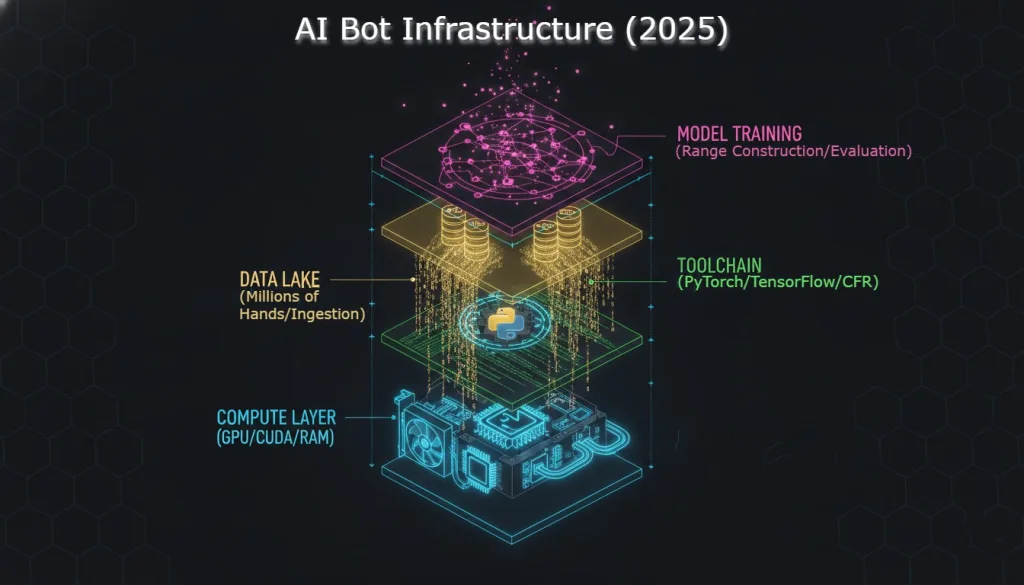
A different stack will be needed by developers who want to replicate the experience of the Shanky or to move to a real AI.
Contemporary Developer Requirements.
- Hardware requirements for the training of the model are the following hardware: a GPU workstation with CUDA support and the suggestion of having 16-32GB RAM to handle large data sets.
- Required OS and Toolchain are Linux or Newer Windows operating system and Python/PyTorch/TensorFlow Tool chain. Specified Solver Integrations are CFR, DCFR and MCCFR.
- Population-level data, contains millions of hand histories, which is very clean and structured data. Labeling pipelines that aim at the identification of exploits, label and exploit adaptive systems that ingest data in real-time.
- Training needs to include large scale iterations of CFR, the construction of ranges, evaluation frameworks, and the comparison of benchmark and baseline solver results.
Developer Note on Depreciation.
Even when you attempt to revive the connector model of Shanky in the present day poker rooms will pick it up. We are witness to the fact that clean data pipelines and not pixel scraping are required.
Since simple Shanky connectors to the current day GPU supported AI pipes we can see how much poker technology has evolved.
Shanky Hold’em Bot Competitors and current Alternatives
The current ecosystem is saturated with Shanky bot alternatives, with majority of them being based on solver engines and current AI poker tools. The first question that most readers will have after reading about the limitations of Shanky is easy to understand: What works today?
Years ago the market had left behind rule-based scripts. Adaptive AI, solver-backed logic and legitimate analytical tools have replaced them.
This is the contemporary environment; and this is where the ecosystem of 3UP belongs.
The Comparison of Legacy and Adaptive.
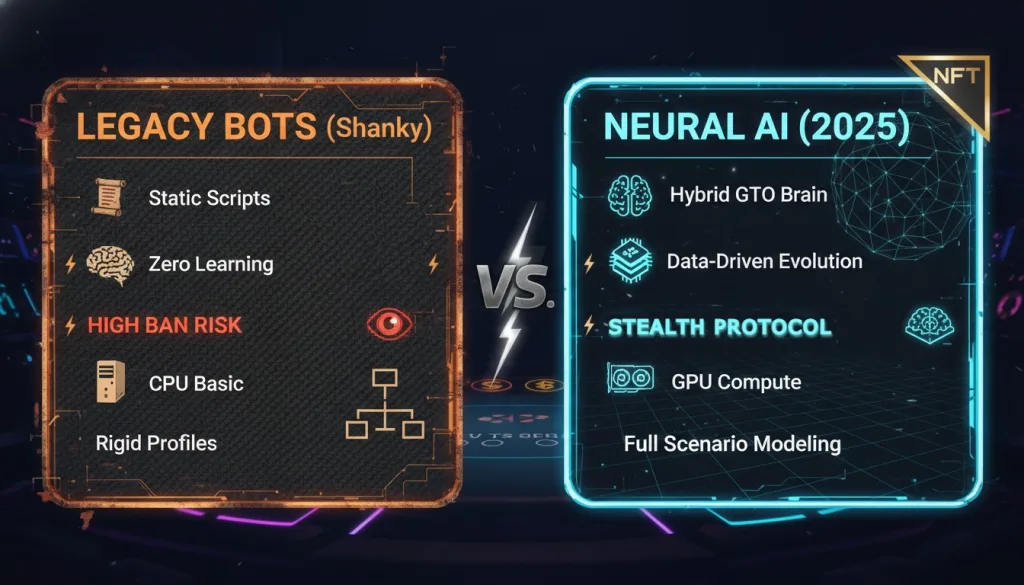
In the case that a user was on the Shanky platform for automation in the past, here are the real transitions in 2025:
- Safe and Legitimate: Solving first Analytical Tools.
- Specialization: Study, out of field training, social knowledge.
- GTO solvers
- Range viewers
- Decision-tree explorers
- Session analyzers
These have developed outside the bounds of service policy.
- Hybrid AI Exploit Environments.
- Target: Engineers of adaptive engines.
- CFR-based pipelines
- Neural exploit modules
- Population modeling
- Off-table real time calibration systems.
- Artificial intelligence, not scripts.
- Enterprise Label Solutions (3UP Ecosystem).
- Focus: Operators, not competitors.
- Anti-fraud systems supported by AI.
- Behavioral-detection engines
- Security dashboards
- Real-time risk scoring
- Integrity modules in tourism.
In the case of B2B companies this is the issue; we see a beyond Shanky white-label technology which also improves the environment. We position present AI, Go To Market, and enterprise white label systems as that which replaces the Shanky model which in turn captures the legacy traffic, and we transform it into high ROI and compliant solutions.
Persuasive at the same time responsible.
Key Takeaways
- The early success of which was seen in Shanky as a consumer poker bot, today that which it brought to the table is more of a historical note.
- It was previsible and at that point easy to see in light of the fact that it was deterministic.
- Connectors and profiles which made Shanky available also proved to be dangerous.
- Shanky’s base requirements are out of date; present is the need for AI to have GPU supported pipelines and real data.
- Today we see that which has replaced the old advanced solvers, adaptive AI and white label enterprise solutions that are much safer, more strategic and which play out in the real world.
- Any effort to play in online poker rooms which run bots is very risky and against the ToS.
- The present generation of AI poker tools and solver powered engines out perform the original Shanky model by a wide margin.
- Today we see that most of the action in the world of Shanky bots is in analysis and security as opposed to gameplay automation.
Further Reading
Peer-Reviewed Research and Foundational Research.
- Bowling, M., et al. (2015). The solution to heads-up limit hold-em poker.
- Zinkevich, M., et al. (2007). Regret Minimization in Incomplete Information Games.
- Brown, N., & Sandholm, T. (2019). Superhuman AI in multiplayer poker. Science.
Investigative Journalism and Industry Reporting.
- Bloomberg News Investigation (c. 2018). On the industrial level of the Bot Farm Corporation (BFC) of Omsk, Russia.
- New York Times Investigation (2008-2011). Reported on the business scandal of the Shanky Hold’em Bot, its mass distribution and how it has compelled large online poker sites to invest heavily in improving their anti-bot systems.
Authoritative Context & Ethical Frameworks.
- PokerStars, GGPoker, and others Terms of Service. The legal terms of all major online poker operators specifically forbid the use of automated software (bots).
- Nose/Petter, B. (2022). Exploitative Poker AI: The Patrick Bot and the GTO Limitations. PokerAI Journal.
Further Reading (Internal Linking)
- On Poker AI and GTO Engines.
- Online Poker Fraud Detection Systems.
- How 3UP Gaming develops fair and secure poker platforms.
- Beginner Guide: Poker Software and Tech Base.
Glossary
- CFR: Counterfactual Regret Analysis which is the basis of GTO solvers.
- GTO: Game Theory Perfect.
- Profile: A preprogrammed configuration file for bots.
- Connector: Software that connects the bot to poker room clients.
- RTA: Real Time Assistance, from today’s advanced AI.
FAQ: What Is Shanky Hold’em Bot?
- What is the Shanky Hold’em Bot?
- The Shanky Hold’em Bot was a very early online poker bot which we developed using scripted automation instead of AI. If someone looked for what is a Shanky bot at the time, they would find out that it was the most recognizable consumer grade product of its era.
- How do the algorithms in the Shanky Bot work at the table?
- It followed set out poker bot strategies and static decision trees. Unlike modern GTO poker bot models which learn and adapt Shanky could not.
- Can players change out the bot’s strategy?
- Yes. Users could create and use their own Shanky bot scripts out of a selection of profiles which in turn made up a very basic version of a customized poker bot which is at large still predictable.
- In 2025 will the Shanky Hold’em Bot still be used?
- No. Today it is easy for modern platforms to detect legacy poker bot software and also that which is put forth today’s online poker bot violates terms of service.
- Which poker sites did the Shanky Bot support?
- Shanky integrated with many legacy poker rooms via local connectors. Those integrations do not work now which is the reason why most users are looking for Shanky bot alternatives* today.
- How did Shanky do with his strategy?
- It was that which we put into script the poker bot strategy did defeat low level opponents in the past but in present time it does very poorly in comparison to what we have in modern solvers and AI poker tools.
- What is the risk of using poker bots online?
- All platforms out against bots. We see also that which puts forward an online poker bot is to be banned, has their assets seized, and which also gets into legal trouble.
- Are present day AI options which replace Shanky Bot?
- Yes. Modern AI poker tools and outgrow the past bots. These are the best Shanky bot alternatives when used for off table study.
- Was Shanky a GTO or exploitative bot?
- Neither. It did not use a GTO poker bot or an exploitative engine. Play was based on fixed scripts.
- Do developers still have access to update Shanky style bot profiles?
- Some archived Shanky bot profiles exist, but developers have moved away from them. It is out of date for a modern; poker bot developer which instead focuses on CFR based systems.